Ankara --:-- · —
bilgi@utuhukuk.com
0536 593 16 00

UTU Hukuk ve Danışmanlık10 min readUpdate:
Idle-period pay, that is, the wages and other entitlements paid to an employee who wins a reinstatement action for the period during which they were not employed until the judgment became final, up to a maximum of four months, is examined in this article. The two heads of claim we most frequently encounter in Reinstatement Actions are idle-period pay and compensation for non-reinstatement. In this article we will discuss what Idle-Period Pay is and how it is calculated.
Idle-Period Pay is an institution aimed at compensating the economic loss suffered by the employee as a result of an unlawful termination and at ensuring job security.
In other words, it is the consideration for the wages of which an employee dismissed by the employer has been deprived because they did not, and could not, actually work.
Article 21 of the Labour Law provides: “For the period during which the employee was not employed until the judgment became final, the employee shall be paid the wages and other entitlements accrued for up to a maximum of four months.”
“For the period during which the employee was not employed until the judgment became final, the employee shall be paid the wages and other entitlements accrued for up to a maximum of four months.”
Labour Law, Art. 21
Upper limit · 4 months
Accordingly, however many months the employee was in fact not employed, idle-period pay is awarded for a maximum of 4 months.
To be entitled to idle-period pay, the employee must bring a reinstatement action within the statutory period and the action must be decided in their favour. Thereafter, the employee must notify the employer, again within the statutory period (ten working days) from service of the final court judgment, that they wish to return to work. However, entitlement to idle-period pay is not conditional on whether or not the employee is reinstated. If the employee does not give notice of their wish to return to work within that period, they will be deemed not to have exercised the right to reinstatement and, consequently, will not be entitled to idle-period pay either. In short, what matters is that the employee has applied to the employer for reinstatement.
To explain step by step:
Boşta geçen süre ücreti kural olarak işçinin giydirilmiş ücreti üzerinden hesaplanır. Dolayısıyla işçinin çıplak ücretinden ibaret değildir. İşçinin boşta geçen süre zarfında fiilen çalışmadığı ancak kanun gereği çalışmış sayılarak maddi olarak uğradığı ekonomik kaybın telafi edilmesi amaçlandığı unutulmamalıdır. Bu nedenle işçinin ücretinin yanı sıra işbu ücrete ek olarak işçiye düzenli olarak sağlanan diğer parasal veyahut para ile ölçülebilen değerler boşta geçen süre ücretinin hesaplanmasında dikkate alınacaktır.
Items in the calculation of idle-period pay
| Item | Included in the calculation? |
|---|---|
| Last gross wage (including pay rises) | Included |
| Regularly paid bonuses and premiums | Included as a rule |
| Turnover, target and sales quota bonuses | Not included |
| Travel allowance in cash | Included |
| Travel allowance in kind (shuttle service) | Not included |
| Meal allowance (in cash or in kind) | Included |
| Accommodation allowance | Not included |
| Regular social benefits | Included |
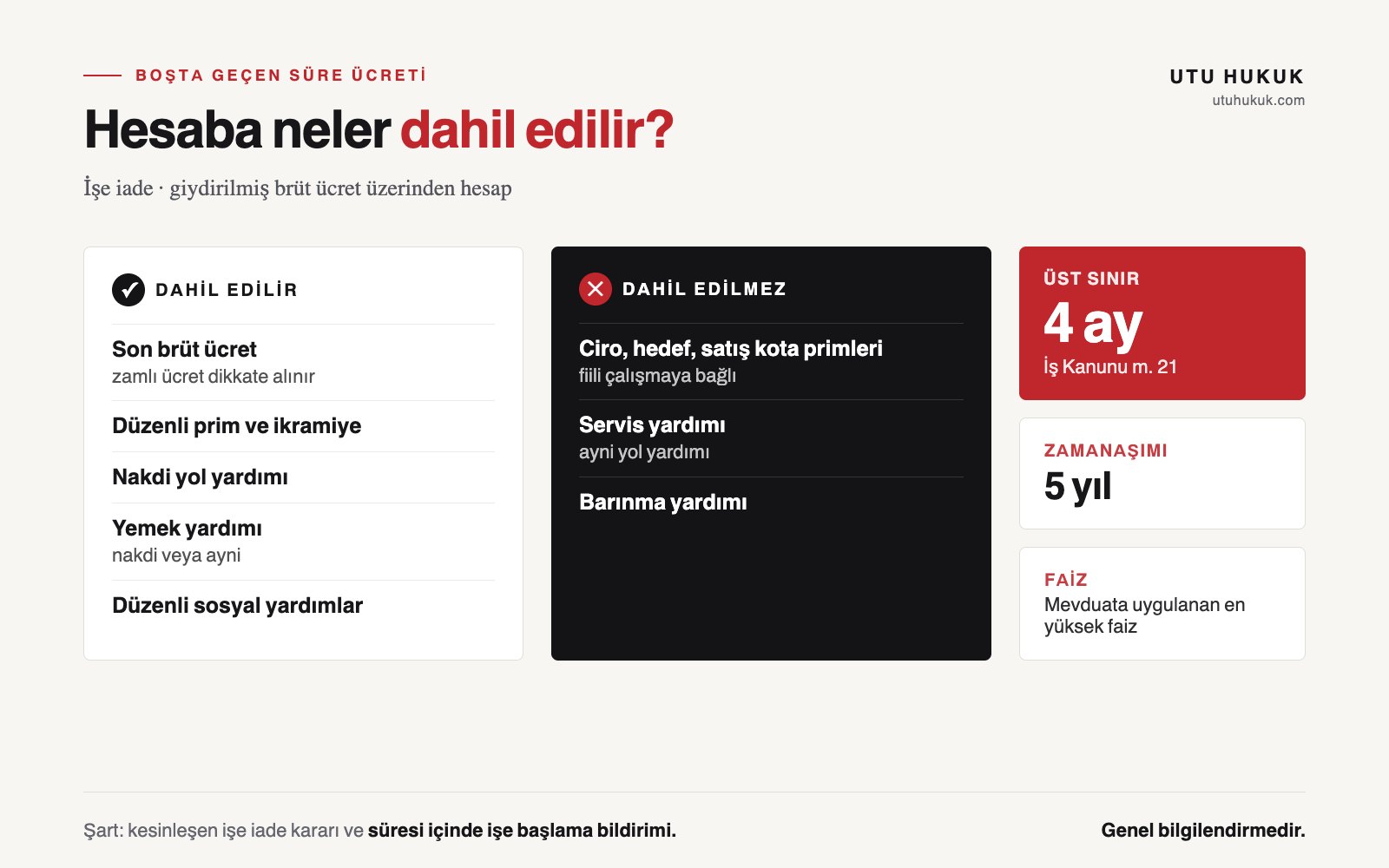
Other monetary benefits or benefits measurable in money in addition to the wage vary according to the nature of each job and workplace, but below we address the items we encounter most frequently:
The most fundamental element of idle-period pay is the employee’s last gross wage. The point to note here is that, although the employee’s wage at the date of the action is taken into account in determining the last wage, pay rises applied to the employee’s wage during the period between the date of termination and the date of the action must also be taken into account. Accordingly, the last wage here is not merely the employee’s wage on the date of dismissal; the wage the employee would have earned had they continued to work (the wage including pay rises) will also be taken into account.
Bonuses and premiums paid regularly to the employee are, as a rule, included in idle-period pay. However, receivables dependent on the employee’s actual work are excluded from the calculation. Accordingly, for example, turnover bonuses, target bonuses (bonuses dependent on the achievement of certain targets) and sales quota bonuses are not included.
Included
Bonuses and premiums paid regularly to the employee.
Not included
Receivables dependent on actual work, such as turnover bonuses, target bonuses and sales quota bonuses.
As is well known, the employer may provide travel and meal allowances at the workplace either in kind or in cash. The circumstances in which travel and meal allowances are added to idle-period pay have been shaped by the case law of the Court of Cassation.
Where the travel allowance is provided in cash, its monetary value is added to idle-period pay. Where the travel allowance is provided in kind, in other words where the employee is provided with a shuttle service, it cannot be included in idle-period pay, since the employee did not actually work and therefore did not commute to work.
This is because, according to the case law of the Court of Cassation, it is not included on the ground that the employee suffered no loss of income in a positive sense, nor was there any amount the employee was unable to save or that was lost from their assets.
If the amount cannot be determined
Another point shaped by the case law of the Court of Cassation is as follows. If the amount of the travel allowance at the date of the action cannot be ascertained, the travel allowance’s monetary value is determined by reference to 7 per mille of the minimum wage. Within the jurisdiction of Istanbul, it is observed that the monthly subscription fee of the İstanbulkart is generally taken into account.
The case law of the Court of Cassation has made it clear that the meal allowance must be added to idle-period pay in all cases, whether it is provided in cash or in kind (that is, where the employer provides the employee with meals at the workplace).
Although it was considered that the shuttle service allowance should not be added to idle-period pay because the employee would not be commuting to work during the period in which they did not go to work, it was held that the meal allowance, whether provided in kind or in cash, must in all cases be added to idle-period pay, because during the 4-month period in which the employee did not commute to work they had to meet their meal needs from their own means and make good themselves the gap created by the loss of the meal allowance.
If the amount cannot be determined
Another point shaped by the case law of the Court of Cassation is as follows. If the amount of the meal allowance at the date of the action cannot be ascertained (for example, where it has been proved by witness statements that meal cards were provided at the workplace but the amount cannot be precisely determined), the meal allowance’s monetary value is determined by reference to 7 per mille of the minimum wage.
Travel allowance
Added if in cash; not added if provided in kind as a shuttle service.
Meal allowance
Added in all cases, whether in cash or in kind.
Where the employer provides the employee with accommodation at the workplace, the accommodation allowance cannot be included in idle-period pay either, since the employee did not actually benefit from it during the idle period and did not have to incur substitute expenditure. The provision of accommodation at construction sites abroad is an example of this situation.
Social benefits provided to the employee regularly and on a continuous basis must also be added to idle-period pay.
In calculating idle-period pay, the employee’s last gross wage must first be determined. Next, the additional entitlements paid regularly and on a continuous basis are identified and added. Once they have been added, the gross wage including fringe benefits is obtained. The gross wage including fringe benefits thus obtained is applied for the period determined by the court, which is a maximum of four months. Statutory deductions are taken into account at the enforcement stage.
The idle-period pay receivable falls within the definition of wages. Therefore, under Article 34 of the Labour Law, the highest interest rate applied by banks to deposits applies.
Since idle-period pay is subject to the provisions applicable to wages within the meaning of Article 32 of the Labour Law, the limitation period for idle-period pay is 5 years. The limitation period starts to run when the employee is not reinstated within one month of service on the employer of the request to return to work.
Interest
The highest interest rate applied by banks to deposits (Labour Law Art. 34).
Limitation
5 years; it starts to run when the employee is not reinstated within one month of service of the request to return to work.
For other receivables arising from the termination of the employment contract, you may also refer to our articles on notice pay and yıllık izin ücreti yazılarımıza da bakabilirsiniz.
For idle-period pay to be calculated correctly, documents relating to both the periods and the components of the wage should be assessed together:
Periods
Wage components
Related legislation: Labour Law No. 4857 (mevzuat.gov.tr)
Idle-Period Pay is an institution aimed at compensating the economic loss suffered by the employee as a result of an unlawful termination and at ensuring job security. In other words, it is the consideration for the wages of which an employee dismissed by the employer has been deprived because they did not, and could not, actually work.
Under Article 21 of the Labour Law, for the period during which the employee was not employed until the judgment became final, the employee is paid the wages and other entitlements accrued for up to a maximum of four months. However many months the employee was in fact not employed, idle-period pay is awarded for a maximum of 4 months.
No. The two separate heads of claim most frequently encountered in reinstatement actions are idle-period pay and compensation for non-reinstatement.
A reinstatement action must have been brought in time, the action must have been decided in the employee’s favour and the court judgment must have become final; the employee must then notify the employer within the prescribed period that they wish to exercise the right to reinstatement.
Idle-period pay is not conditional on whether or not the employee is reinstated. However, if the employee does not give notice within the prescribed period of their wish to return to work, they are deemed not to have exercised the right to reinstatement and are not entitled to idle-period pay either.
Where the travel allowance is provided in cash, its monetary value is added to idle-period pay; where it is provided in kind in the form of a shuttle service, it is not included. The meal allowance, on the other hand, is added in all cases, regardless of whether it is provided in cash or in kind.
Bonuses and premiums paid regularly to the employee are, as a rule, included in idle-period pay. However, receivables dependent on the employee’s actual work, such as turnover bonuses, target bonuses and sales quota bonuses, are excluded from the calculation.
The idle-period pay receivable falls within the definition of wages. Therefore, under Article 34 of the Labour Law, the highest interest rate applied by banks to deposits applies.
The limitation period for idle-period pay is 5 years. The limitation period starts to run when the employee is not reinstated within one month of service on the employer of the request to return to work.
Consultation request
At UTU Hukuk Danışmanlık, we provide legal services in reinstatement actions, acting as counsel for the parties in both the mediation process and the litigation process, to ensure that idle-period pay is calculated correctly.
Fill in the form and we will call you. You can also contact us directly: