Ankara --:-- · —
bilgi@utuhukuk.com
0536 593 16 00

UTU Hukuk ve Danışmanlık11 min readUpdate:
Notice pay, is the compensation payable by the party that terminates an employment contract of indefinite duration without complying with the statutory notice period. The receivables that arise when an employment contract ends vary according to who terminated the contract and on what ground. In this article, we consider the conditions under which notice pay may be claimed, the notice periods and how the compensation is calculated. We limit our review to employment relationships within the scope of the Labour Law No. 4857.
As a rule, a party wishing to end an employment relationship of indefinite duration by termination with notice must allow the other party time to prepare. During this period, the employee may look for a new job, and the employer may assess how the departure will affect the organisation of the workplace and make the necessary preparations.
Ending the contract without granting the required period gives rise, for the terminating party, to notice pay an obligation to pay.
When examining severance pay and notice pay, the provisions on which these two receivables are based must be distinguished. While Article 14 of Law No. 1475 continues to apply to severance pay, we assess notice pay under Article 17 of Law No. 4857. Indeed, Article 120 of Law No. 4857 kept in force only Article 14 of the former Labour Law, which concerns severance pay.
Severance pay
Its legal basis is Article 14 of Law No. 1475, which was kept in force.
Notice pay
Its legal basis is Article 17 of the Labour Law No. 4857.
In a claim for notice pay, the legal nature of the contract must first be determined. If a validly concluded fixed-term contract ends because the agreed end date has been reached, notice pay cannot be claimed. Where such a contract is unlawfully terminated early, however, other compensation provisions may come into play.
Dikkat
That said, writing an end date into the contract is not sufficient on its own; the conditions required by Article 11 for a fixed-term contract must also be met.
Who may claim notice pay is determined by examining who terminated the contract and whether the notice obligation was fulfilled. Where the employer dismisses the employee immediately in the absence of any circumstance removing the notice requirement, the employee may claim compensation. Likewise, an employee who leaves the job without granting the required period may be liable to the employer. Completion of one year’s service is not a condition for this receivable; the length of service determines how many weeks’ notice is required.
In the light of these explanations, the following elements are assessed together in a claim for notice pay:
The other option available to the employer is, instead of having the employee work throughout the notice period, to pay the equivalent of that period in advance. The payment must be calculated in accordance with the wage principles in Article 17. Choosing this route does not affect severance pay, where its conditions are met, or the employee’s other receivables. For employees who benefit from job security, the termination must also comply with those provisions.
In certain events, the Law permits the employment relationship to be ended without waiting for the notice period. This right, regulated in Article 24 for the employee and Article 25 for the employer, covers health-related circumstances, conduct contrary to morality and good faith, and force majeure. For the employer, absence caused by police custody or detention exceeding the statutory notice period is also regulated separately. However, stating one of these grounds in the termination letter is not sufficient; the conditions required for termination for just cause must have been met in the specific case.
Where the conditions for immediate termination for just cause are met, the terminating party does not pay notice pay because it has not granted the notice period. An employee who terminates cannot claim notice pay for themselves on the basis of this departure; severance pay and other receivables are dealt with according to their own conditions.
Exception · Probationary period
Furthermore, if the contract contains a valid probationary clause, there is no notice obligation for a termination within the probationary period under Article 15. However, wages for the days worked during the probationary period and other accrued rights must be paid.
The grounds for termination for just cause are the employee’s right of immediate termination for just cause and the employer’s right of immediate termination for just cause discussed in detail in our articles.
How much longer the employment relationship continues after notice depends on the employee’s length of service. The minimum periods adopted in Article 17 of the Labour Law and their equivalents in days can be shown as follows:
Notice periods under Article 17 of Labour Law No. 4857
| Employee’s length of service | Notice period | Equivalent in days |
|---|---|---|
| Less than six months | 2 hafta | 14 days |
| From six months to one and a half years | 4 hafta | 28 days |
| From one and a half years to three years | 6 hafta | 42 days |
| More than three years | 8 hafta | 56 days |
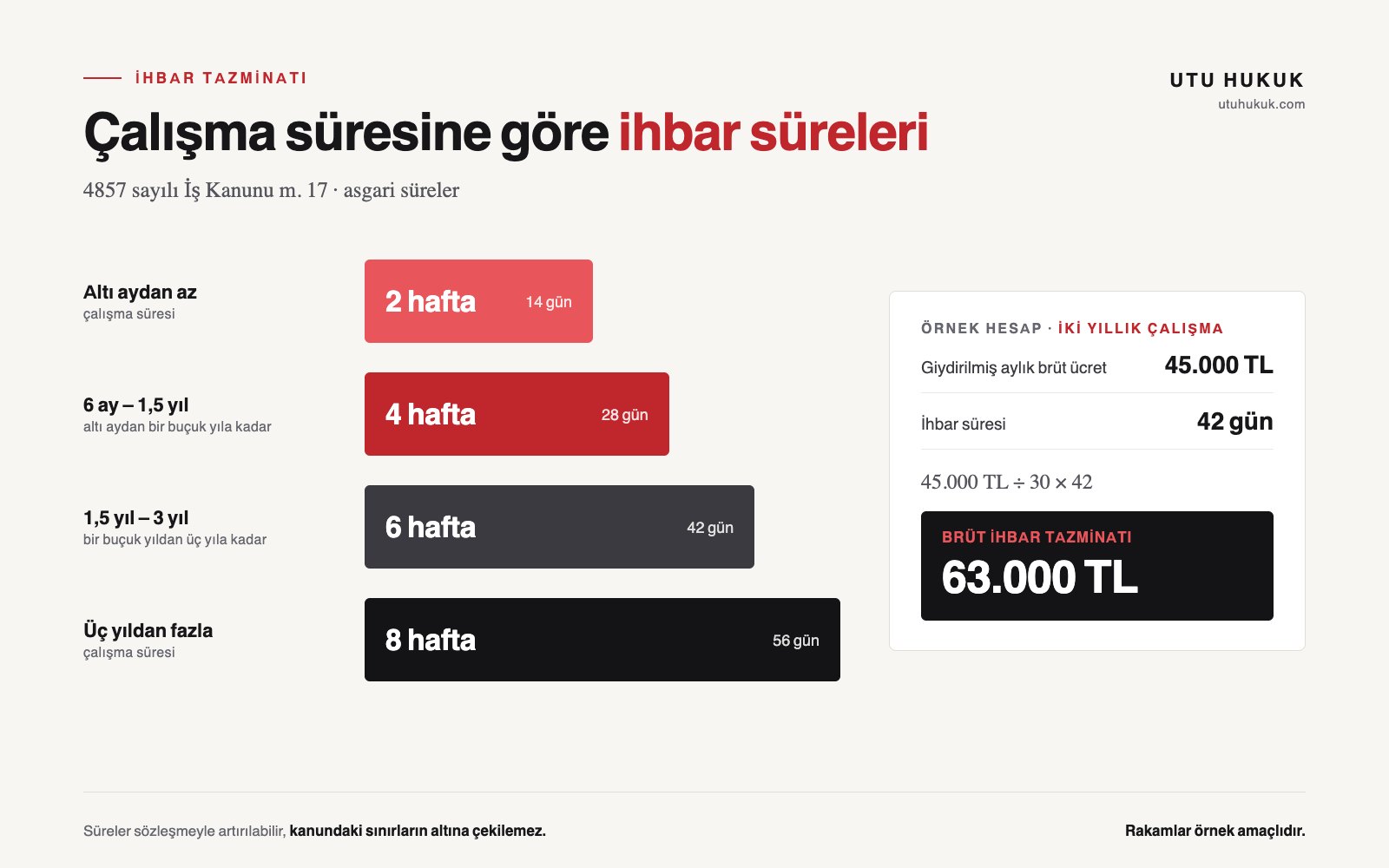
The parties may provide for a longer notice period by contract; they cannot reduce these periods below the statutory limits. If the notice period has been duly completed, notice pay cannot also be claimed.
Indivisibility of the period
The indivisibility of the period should also be borne in mind here. A unilateral practice of having the employee work part of the period and paying for the remainder is not sufficient for the notice obligation to be deemed properly fulfilled.
While continuing to work at the workplace they are leaving, the employee needs time to apply for a new job. Article 27 therefore provides that at least two hours on each working day during the notice period must be set aside for job seeking, without any reduction in wages. This leave also applies where the notice is given by the employee. An employee wishing to use the leave collectively must inform the employer in advance and use the accumulated hours in the days before their departure.
Failure to grant the time required for job seeking, in whole or in part, entitles the employee to claim wages for the hours concerned. If the employer has made the employee work during these hours, the payment is calculated differently: in addition to the normal wage to which the employee is entitled because of the leave, the work performed is paid at a 100 per cent increase.
Hesaplamaya başlarken işçinin son brüt ücreti belirlenir. Ardından, kanun veya sözleşme gereğince sağlanan ve parasal değeri hesaplanabilen düzenli ek menfaatler değerlendirilir. Örneğin yemek ve yol yardımları ya da süreklilik gösteren ikramiyeler, ilgili döneme düşen tutarlarıyla hesaba katılabilir. Böylece uygulamada giydirilmiş brüt ücret olarak ifade edilen hesaplama tutarına ulaşılır.
In a calculation based on the monthly wage, the gross wage including fringe benefits is first divided by thirty to find the daily amount. The resulting amount is multiplied by the number of days in the notice period. For example, suppose that the monthly gross wage including fringe benefits of an employee who has worked for two years is TRY 45,000. If the contract contains no provision extending the period, a six-week, i.e. 42-day, period is taken as the basis:
This gives the amount of compensation before deductions. To determine the net payment to the employee, the statutory deductions must also be calculated.
When assessing the form of the termination notice, the 2025 legislative amendment must not be overlooked. Article 109, amended by Article 23 of Law No. 7555 and in force since 24 July 2025, requires written procedure to be followed for notices aimed at ending the contract. In view of this provision, we cannot regard the written form rule as limited to notices given by the employer. If the addressee of the notice refuses to sign, the refusal must be documented in a record.
The existence of the written form rule and the consequences of breaching it must be considered separately. The effect of the new provision is debatable, particularly for terminations outside the scope of job security. It would therefore be wrong to state in advance that an oral statement will be ineffective in every case, or that written form in a notice given by the employee is always relevant only as a matter of proof. The assessment must be made on the basis of the type of termination and the applicable provisions.
In a termination by an employer subject to the job security provisions, the procedure required by Articles 18 and 19 must be followed. When notifying its decision in writing, the employer must also explain unambiguously the specific ground on which it relies. Where the employee’s conduct or performance is cited as the reason, the employee must, save for the statutory exception, be given the opportunity to present a defence before the decision is taken. These steps are taken into account when the validity of the termination is examined.
Notice pay and reinstatement
Bildirim için yeterli zaman bırakılması veya ihbar karşılığının ödenmesi, fesih sebebinin geçerli olup olmadığı sorununu kendiliğinden çözmez. Dolayısıyla iş güvencesinden yararlanan bir işçi, ihbar tazminatı kendisine ödenmiş olsa da koşulları varsa işe iade yoluna başvurabilir.
In a claim for notice pay, determining the termination date correctly is also necessary for calculating the limitation period. The five-year period under Additional Article 3 of the Labour Law begins to run upon termination, when the receivable becomes due. This rule applies to employment contracts ending after 25 October 2017. For earlier terminations, the relationship established by Provisional Article 8 with the previous periods must be examined separately.
If a notice pay dispute is to be resolved through litigation, the first step is arabuluculuk the application. Article 3 of the Labour Courts Law No. 7036 requires that, in claims by both the employee and the employer concerning this receivable, mediation be pursued first. If the negotiations fail, an application may be made to the labour court. The period between the date of application to the mediation office and the final record is not counted towards the limitation period; the period is suspended during this time.
When preparing the application, the contract, length of service, wage records and documents showing how the departure took place should be assessed together. For both employees and employers, the following points help the process run smoothly:
For employees
For employers
Related legislation: Labour Law No. 4857 (mevzuat.gov.tr)
Notice pay is the compensation paid to the other party by the party that terminates an employment contract of indefinite duration without complying with the statutory notice period. Its legal basis is Article 17 of the Labour Law No. 4857.
İhbar tazminatı için bir yıllık kıdemin tamamlanması şart değildir; hizmet süresi, kaç haftalık bildirim gerektiğini belirler. Altı aydan az çalışan işçi için bildirim süresi 2 haftadır.
İş Kanunu’nun 17. maddesine göre çalışma süresi altı aydan az olan işçi için 2 hafta, altı aydan bir buçuk yıla kadar 4 hafta, bir buçuk yıldan üç yıla kadar 6 hafta, üç yıldan fazla olan işçi için 8 haftadır. Taraflar sözleşmeyle daha uzun süre öngörebilir, bu süreleri kısaltamaz.
Hesaplama giydirilmiş brüt ücret üzerinden yapılır: Giydirilmiş brüt ücret otuza bölünür ve ihbar süresindeki gün sayısıyla çarpılır. Bu işlem kesintilerden önceki tutarı verir; işçiye yapılacak net ödeme için yasal kesintilerin de hesaplanması gerekir.
İhbar tazminatını, bildirim süresine uymadan sözleşmeyi fesheden taraf öder. Gerekli süreyi tanımadan işi bırakan işçi işverene karşı sorumlu olabilir. Haklı nedenle derhal fesih yapan işçi de bu ayrılığa dayanarak kendisi için ihbar tazminatı isteyemez; kıdem tazminatı ve diğer alacakları kendi koşullarına göre ele alınır.
Sözleşmede geçerli bir deneme kaydı varsa, deneme dönemi içindeki fesihte İş Kanunu’nun 15. maddesi gereğince ihbar yükümlülüğü bulunmaz. Deneme sırasında çalışılmış günlere ait ücretler ve doğmuş diğer haklar ise ödenmelidir.
Evet. Bildirim için yeterli zaman bırakılması veya ihbar karşılığının ödenmesi, fesih sebebinin geçerli olup olmadığı sorununu kendiliğinden çözmez. İş güvencesinden yararlanan bir işçi, ihbar tazminatı kendisine ödenmiş olsa da koşulları varsa işe iade yoluna başvurabilir.
İş Kanunu’nun ek 3. maddesindeki beş yıllık zamanaşımı süresi, fesihle birlikte işlemeye başlar. Bu kural 25 Ekim 2017 tarihinden sonra biten iş sözleşmeleri için geçerlidir; daha eski fesihlerde ayrıca inceleme yapılmalıdır.
Evet. 7036 sayılı İş Mahkemeleri Kanunu’nun 3. maddesi, hem işçinin hem de işverenin ihbar tazminatına ilişkin davalarında önce arabuluculuğa gidilmesini arar. Görüşmeler sonuçsuz kalırsa iş mahkemesine başvurulabilir.
Consultation request
As UTU Hukuk Danışmanlık, we provide legal advisory and representation services to employees and employers in disputes arising from notice pay, severance pay and the termination of employment contracts. We handle the assessment of notice periods, the calculation and collection of compensation claims, mediation negotiations and litigation according to the circumstances of each case.
Fill in the form and we will call you. You can also contact us directly: