Ankara --:-- · —
bilgi@utuhukuk.com
0536 593 16 00

UTU Hukuk ve Danışmanlık7 min readUpdate:
The gross wage including fringe benefits, i.e. the wage obtained by adding to the employee’s basic wage money or monetary-value benefits such as travel, meals, premiums and bonuses, is the wage on which receivables such as severance pay and notice pay are calculated. In practice, net wage is frequently confused with basic wage, and the gross wage including fringe benefits with gross wage. In this article, we will try to explain the differences between all of these in simple and clear language.
Labour Law No. 4857’s Article 32 regulates “Wage” in labour law as follows:
“Article 32 – Wage in the general sense is the amount provided to a person by the employer or third parties in return for work and paid in money.”
Labour Law No. 4857, Art. 32
Thinking of wage along two separate axes makes the distinctions easier:
These two distinctions are independent of each other; as the example below shows, a wage can be both gross and basic at the same time.
The Basic Wage, as stated above, refers to the amount paid to the employee in return for performing the work.
When calculating the basic wage, no additional payment is taken into account beyond the amount paid in return for the work performed. Accordingly, the basic wage is the core wage agreed solely in return for the work performed by the employee, excluding additional allowances, premiums or social benefits.
Exception · Court of Cassation case law
The exception to this concerns the wages of lorry drivers making international trips. According to the case law of the Court of Cassation, the international trip premium is regarded not as a supplement to the wage but as having the nature of wage.
The Gross Wage Including Fringe Benefits, on the other hand, refers to the wage obtained by adding to the principal wage the money or monetary-value benefits provided to the employee.
For example, items such as travel allowance, meal allowance, bonuses, premiums, social benefits (fuel, clothing, rent, education, food, etc.) and insurance payments are payments included in the gross wage including fringe benefits. In practice, the gross wage including fringe benefits also corresponds to the definition of wage in the broad sense.
Fuel, clothing, rent, education and food allowances are classed as social benefits.
Severance pay, notice pay, bad-faith compensation and idle-period pay are calculated on the basis of the gross wage including fringe benefits. However, it should not be overlooked that, when calculating idle-period pay, items that depend on actual work are not included in the calculation. It is also worth noting that wage items such as overtime pay, pay for national and public holidays (UBGT) and weekly rest day pay are among the items not included in the gross wage including fringe benefits.
The relationship between employee receivables and the gross wage including fringe benefits
| Calculated on the gross wage including fringe benefits | Items not included in the gross wage including fringe benefits |
|---|---|
| Severance pay | Overtime pay |
| Notice pay | Pay for national and public holidays (UBGT) |
| Bad-faith compensation | Weekly rest day pay |
| Idle-period pay* |
* For idle-period pay, items that depend on actual work are not included in the calculation.
Kullanılmayan izinlerin hangi ücret üzerinden hesaplandığını ise yıllık izin ücreti in our article.
Gross wage
The Gross Wage is the total amount stated in the employment contract before any statutory deductions (employee social security contribution, unemployment insurance contribution, income tax, stamp duty) have been made.
Net wage
The Net Wage is the amount determined after all statutory deductions have been made from the gross wage.
The statutory deductions made in moving from the gross wage to the net wage are as follows:
To Simplify with an Example:
Suppose an employee’s salary is set in the contract at TRY 30,000 gross. Suppose this employee is also given a meal card of TRY 3,000 and a travel allowance of TRY 2,000 every month. Suppose that, after statutory deductions, TRY 22,000 is paid into the employee’s bank account.
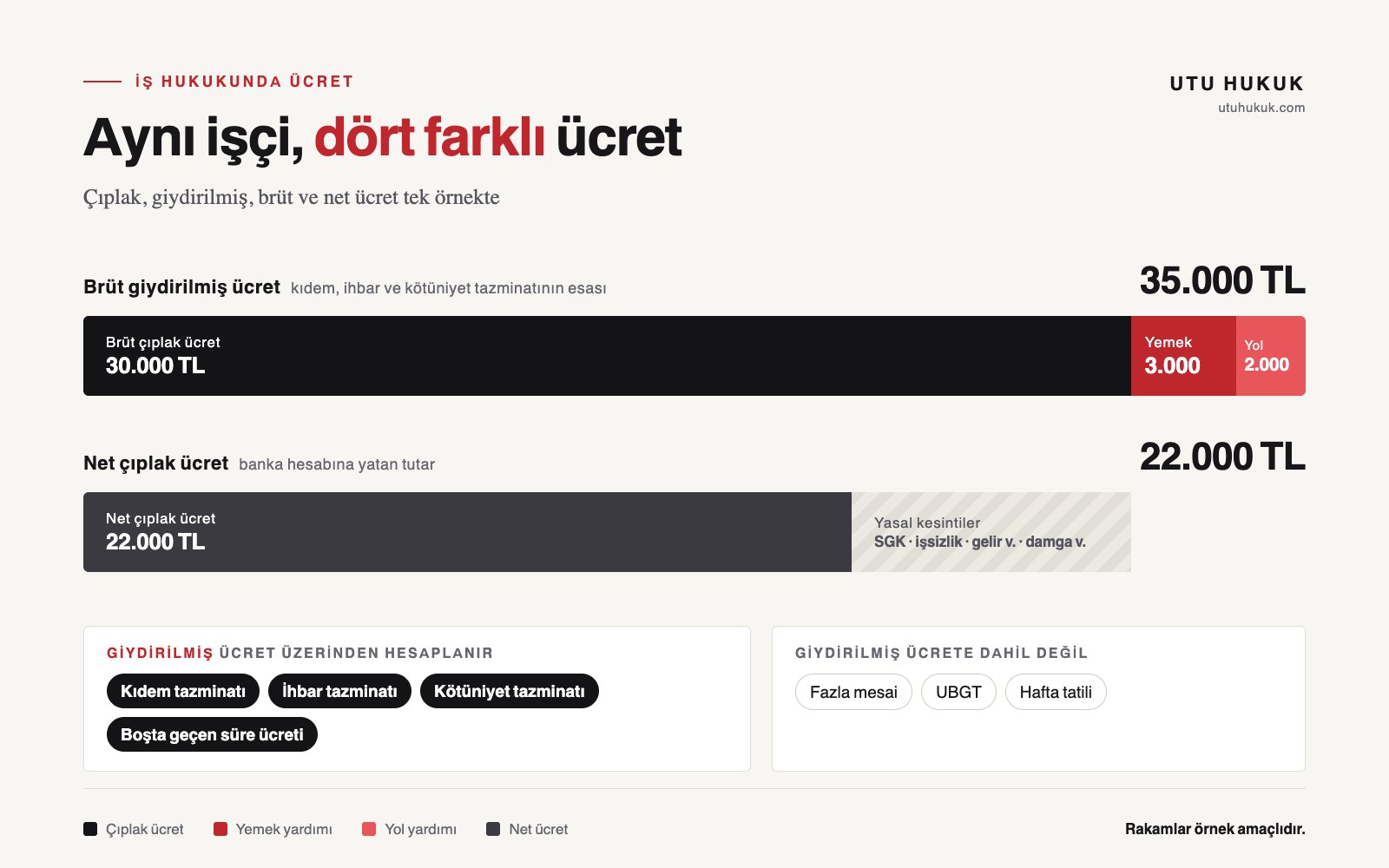
Gross Basic Wage: TRY 30,000, Net Basic Wage: TRY 22,000, Gross Wage Including Fringe Benefits: TRY 35,000 (30,000 + 3,000 + 2,000).
Although the amount paid into the employee’s bank account in the example is TRY 22,000, receivables such as severance pay and notice pay are calculated on the basis of the gross wage including fringe benefits.
Where a dispute arises between the parties, the question of wage is of importance in Employee Receivables Actions heard before the Labour Courts. Here, after all evidence has been collected and the witnesses heard, the Labour Court judge has the wage determined through an expert witness specialising in labour law, and the receivables are calculated.
In the calculations to be made, matters such as the nature of the wage, wage supplements and the correct identification of the items to be added to the gross wage including fringe benefits are important for the proceedings to be conducted correctly.
For the pre-action process in such disputes between employees and employers, you may also refer to our article on arabuluculuk, and for the documents signed upon termination of the employment relationship, to our article on release deeds in labour law .
Since the nature of the wage and wage supplements are important in the proceedings, the following points help the process run smoothly for both employees and employers:
For employees
For employers
Related legislation: Labour Law No. 4857 (mevzuat.gov.tr)
The gross wage including fringe benefits ("dressed wage") refers to the wage obtained by adding to the principal wage the money or monetary-value benefits provided to the employee. Travel allowance, meal allowance, bonuses, premiums, social benefits and insurance payments are payments included in the gross wage including fringe benefits. In practice, the gross wage including fringe benefits also corresponds to the definition of wage in the broad sense.
The basic wage is the core wage agreed solely in return for the work performed by the employee, excluding additional allowances, premiums or social benefits. It is generally set as a fixed monthly wage or an hourly wage; in practice it is also referred to as the principal wage or base wage.
When calculating the basic wage, no additional payment is taken into account beyond the amount paid in return for the work performed. The gross wage including fringe benefits, on the other hand, also covers the money or monetary-value benefits provided to the employee in addition to this principal wage.
The gross wage is the total amount stated in the employment contract before any statutory deductions (employee social security contribution, unemployment insurance contribution, income tax, stamp duty) have been made. The net wage is the amount determined after all statutory deductions have been made from the gross wage.
Severance pay, notice pay, bad-faith compensation and idle-period pay are calculated on the basis of the gross wage including fringe benefits. However, when calculating idle-period pay, items that depend on actual work are not included in the calculation.
No. Wage items such as overtime pay, pay for national and public holidays (UBGT) and weekly rest day pay are among the items not included in the gross wage including fringe benefits.
According to the case law of the Court of Cassation, the international trip premium is regarded not as a supplement to the wage but as having the nature of wage. This is an exception to the rule that additional payments are not taken into account in calculating the basic wage.
After all evidence has been collected and the witnesses heard, the Labour Court judge has the wage determined through an expert witness specialising in labour law, and the receivables are calculated.
Consultation request
As UTU Hukuk Danışmanlık, we provide legal and advisory services to our clients in the field of labour law regarding the determination and calculation of wages.
Fill in the form and we will call you. You can also contact us directly: