Ankara --:-- · —
bilgi@utuhukuk.com
0536 593 16 00

UTU Hukuk ve Danışmanlık9 min readUpdate:
Annual leave pay, that is, the amount paid upon termination of the employment contract in respect of annual leave days that the employee has earned but not used, is a receivable of the employee. In this article we examine the receivable for paid annual leave. When the employment relationship ends, leave that the employee has earned but not used must be paid as wages. In determining this receivable, the length of service, leave records and the last wage are assessed together. Our explanations concern employment relationships within the scope of Labour Law No. 4857.
Paid annual leave allows the employee to take a break from work and rest without suffering a loss of wages.
It is one of the labour law expressions of the right to rest guaranteed by Article 50 of the Constitution. The conditions and exercise of this right are regulated in Article 53 et seq. of Labour Law No. 4857.
Leave cannot be waived
An employee cannot waive the right to annual leave in advance. Nor does an agreement to pay money instead of granting leave while the employment relationship continues relieve the employer of its obligation to grant leave. Unused leave turns into a wage receivable upon termination of the employment contract.
As a rule, entitlement to annual leave requires the completion of at least one year of service. The probationary period is also included in this calculation. Where the employee works at different workplaces belonging to the same employer, the periods are assessed together. Periods that the law deems to have been worked are also taken into account; the assessment therefore cannot be made solely on the basis of days actually worked.
Exception · Seasonal and campaign work
However, the provisions of the Labour Law on annual leave do not apply to seasonal or campaign work which by its nature lasts less than one year. In assessing this exception, the true nature of the work is decisive.
Article 53 of the Labour Law sets annual leave periods according to length of service, subject to the following minimums:
Minimum annual leave periods under Art. 53 of Labour Law No. 4857
| Length of service | Minimum annual leave |
|---|---|
| From 1 year up to 5 years, inclusive of 5 years | 14 days |
| More than 5 years, less than 15 years | 20 days |
| 15 years and over | 26 days |
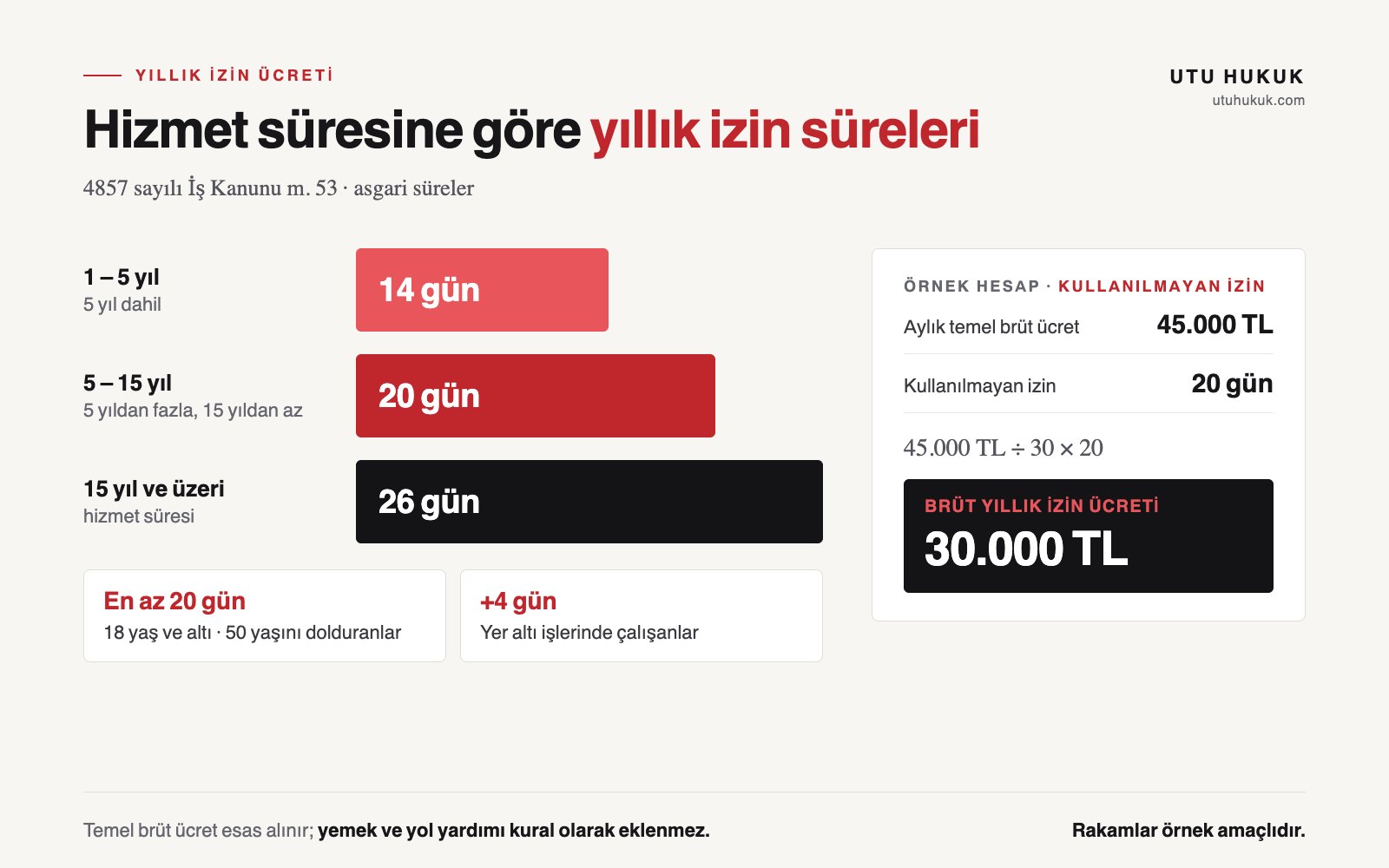
The leave period does not increase by the same amount for each year of service; it changes according to the thresholds in the law. In calculating accrued leave, the number of days earned in each service year is likewise determined separately. The leave period applicable in the final year is not applied to all previous years.
Annual leave for employees aged 18 or under and for employees aged 50 or over is at least 20 days. Where the length of service gives rise to a longer leave entitlement, that period is preserved. Four days are added to the statutory annual leave periods of employees working underground.
The parties may increase the leave period by an employment contract or a collective labour agreement. They may not, however, agree on a period below the statutory limits. For example, where an employee entitled to 14 days’ leave has a contract stating that leave is 10 days, this does not extinguish the remaining four days. Agreeing on 20 days’ leave for the same employee, on the other hand, is possible.
The employer may not unilaterally split annual leave into parts. However, if the parties agree, leave may be taken in different periods provided that one of the parts lasts at least 10 days. It therefore cannot be said that leave must in every case be granted in one go and without interruption.
Weekly rest days, national holidays and public holidays falling within the leave period are not deducted from annual leave days. Sick leave granted during the year and other paid or unpaid leave are not counted as annual leave either. Where the employer terminates the contract, the notice period and the leave for seeking new employment may not overlap with annual leave.
The periods that are not deducted from annual leave days or are not counted as annual leave are as follows:
The employer is obliged to keep records showing employees’ annual leave. In a dispute, the burden of proving that leave was granted also lies with the employer.
Proof
Leave records bearing the employee’s signature, or documents serving the same purpose, are therefore important. Leave taken is deducted from the total entitlement to determine the number of days remaining on the date the employment contract ends.
Article 59 of the Labour Law provides that, when the contract ends, payment must be made in respect of leave that has been earned but not used. The employee’s resignation, termination by the employer for just cause or expiry of a fixed-term contract does not in itself extinguish this receivable. Pay for unused leave may arise even where no entitlement to severance pay or notice pay has been acquired.
Does not in itself extinguish the receivable
The employee’s resignation, termination by the employer for just cause or expiry of a fixed-term contract.
Scope of payment
Leave days that the employee has earned but not used.
The days covered by the payment are limited to the leave the employee has earned. As a rule, no new annual leave entitlement arises pro rata to the time worked in respect of a service year not yet completed. Contractual provisions more favourable to the employee are, however, taken into account separately.
Kullanılmayan izinlerin ücreti, sözleşmenin sona erdiği tarihteki temel brüt ücret üzerinden hesaplanır. Yemek ve yol yardımı gibi sosyal menfaatler kural olarak bu ücrete eklenmez. Aylık sabit ücretle çalışan işçi için günlük tutar, aylık temel brüt ücretin 30’a bölünmesiyle bulunur ve kalan izin günleriyle çarpılır.
For example, suppose that an employee whose last monthly basic gross wage is TRY 45,000 has 20 days of unused leave. The amount to be calculated for these days is as follows:
This example shows the gross receivable. Statutory deductions are assessed separately when determining the net payment to the employee.
The limitation period for annual leave pay starts to run on the date the employment contract ends. The fact that leave for previous years was not used while the employment relationship continued does not cause those days to be lost merely because the year has changed. The calculation therefore cannot be limited to leave earned only in the last five years.
A five-year limitation period applies to annual leave pay arising from employment contracts that ended after 25 October 2017. For earlier termination dates, the transitional provisions should be examined. In assessing whether the period has expired in a specific case, acts that suspend or interrupt the limitation period are also taken into account.
If annual leave pay is not paid, an application must be made to a mediator before an action is brought. If no agreement is reached in the negotiations, the dispute may be taken to the labour court. The limitation period does not run between the application to the mediation office and the drawing up of the final report. When preparing the application, examining documents showing the length of service and the wage together with the leave records ensures that the claim is correctly determined.
We discussed the general operation of the mediation process arabuluculuk in our article.
In assessing an annual leave receivable, the length of service, leave records and the last wage should be considered together. For both employees and employers, the following points help the process run smoothly:
For employees
For employers
Related legislation: Labour Law No. 4857 (mevzuat.gov.tr)
Article 59 of the Labour Law provides that, when the contract ends, payment must be made in respect of leave that has been earned but not used. Unused leave turns into a wage receivable upon termination of the employment contract.
Under Article 53 of the Labour Law, annual leave is 14 days for an employee with a length of service of 1 to 5 years (inclusive of 5 years), 20 days for an employee with more than 5 but less than 15 years of service, and 26 days for an employee with 15 years of service or more. Annual leave for employees aged 18 or under and for employees aged 50 or over is at least 20 days.
The employee’s resignation, termination by the employer for just cause, or expiry of a fixed-term contract does not in itself extinguish this receivable. Pay for unused leave may arise even where no entitlement to severance pay or notice pay has been acquired.
Pay for unused leave is calculated on the basis of the basic gross wage as at the date on which the contract ends. For an employee on a fixed monthly wage, the daily amount is found by dividing the monthly basic gross wage by 30 and is then multiplied by the number of remaining leave days. Statutory deductions are assessed separately when determining the net payment to the employee.
As a rule, social benefits such as meal and travel allowances are not added to this pay; the calculation is made on the basis of the basic gross wage.
An employee cannot waive the right to annual leave in advance. Nor does an agreement to pay money instead of granting leave while the employment relationship continues relieve the employer of its obligation to grant leave.
As a rule, entitlement to annual leave requires the completion of at least one year of service. As a rule, no new annual leave entitlement arises pro rata to the time worked in respect of a service year not yet completed. Contractual provisions more favourable to the employee are, however, taken into account separately.
The employer is obliged to keep records showing employees’ annual leave. In a dispute, the burden of proving that leave was granted also lies with the employer.
The limitation period starts to run on the date the employment contract ends. A five-year limitation period applies to annual leave pay arising from employment contracts that ended after 25 October 2017; an application must be made to a mediator before an action is brought.
Consultation request
At UTU Hukuk, we provide legal advice and representation in disputes concerning paid annual leave receivables and arising from the termination of employment contracts. We provide legal support to employees and employers in assessing unused leave days and the amount of the receivable, in mediation negotiations and in the conduct of litigation.
Fill in the form and we will call you. You can also contact us directly: