Ankara --:-- · —
bilgi@utuhukuk.com
0536 593 16 00
UTU Hukuk ve Danışmanlık8 min readUpdate:
Carrier’s liability, that is, the liability assumed by the carrier under the Turkish Commercial Code for damage arising from loss of or damage to the goods, or from delay in their delivery, from acceptance of the goods for carriage until their delivery. The provisions on “carriage operations” in the Turkish Commercial Code constitute an area that requires highly technical knowledge and touches on more than one branch of law. The “carriage operations” provisions of the Turkish Commercial Code apply to disputes concerning carriage performed within Türkiye. In this article we explain how the carrier’s liability arises, particularly in the carriage of goods/merchandise.
Article 850 TCC defines who the carrier is and what the subject matter of carriage comprises.
“(1) The carrier is the person who, under a contract of carriage, undertakes the carriage of goods or passengers, or both. Goods include any kind of cargo.
(2) Under the contract of carriage, the carrier undertakes to transport the goods to the place of destination and deliver them there to the consignee, or to bring the passenger to the place of destination; in return, in the carriage of goods the consignor, and in the carriage of passengers the passenger, undertakes to pay the freight to the carrier.”
Turkish Commercial Code, Art. 850
Thus the provision establishes that the subject of carriage may be anything, animate or inanimate, such as persons, goods, merchandise or commodities.
First of all, the carrier undertakes, by the contract of carriage, the transport of the goods/merchandise from one place to another. The parties to the contract of carriage may be the consignor and the carrier, or equally the consignee and the carrier.
Consignor and carrier
The contract of carriage may be concluded between the consignor and the carrier.
Consignee and carrier
The contract of carriage may also be concluded between the consignee and the carrier.
The carrier is liable for damage arising from loss, damage and delay occurring during the period from the moment it accepts and begins to carry the goods/merchandise whose carriage it has undertaken under the contract of carriage until their delivery to the consignee’s address at the end of the carriage.
Liability for objective care
Here, the carrier’s liability is a liability for objective care. However, depending on the specific features of the case, different circumstances are taken into account in determining this liability, both by law and by custom.
The relevant articles of the TCC read as follows.
“(1) The carrier is liable for damage arising from loss of or damage to the goods, or from delay in their delivery, during the period from acceptance of the goods for carriage until their delivery.
(2) Where the damage was caused by conduct of the consignor or consignee or by a particular defect of the goods, the extent to which these circumstances contributed shall be taken into account in determining whether the obligation to compensate arises and its scope.
(3) In the event of delay, even if no damage occurs, the freight is reduced in proportion to the length of the delay, unless the carrier proves that it exercised all due care.”
Turkish Commercial Code, Art. 875 · Liability for damage arising from loss or damage and from delay
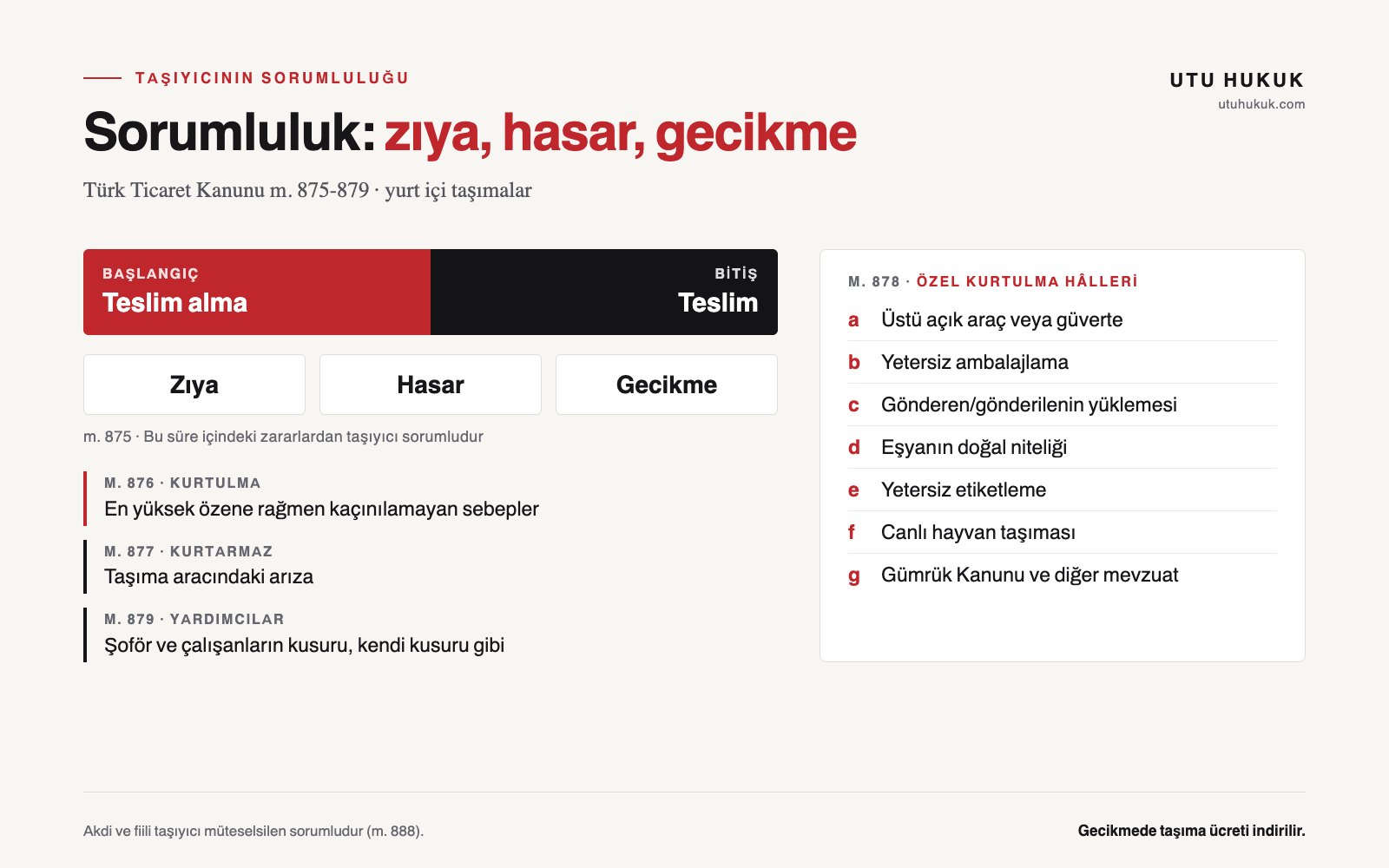
The provisions of Article 875 set out the general framework of the carrier’s liability, and the duration of liability and the circumstances affecting the determination of liability are likewise specified within a general framework. It should not be forgotten that in each carriage operation the liabilities, duties and obligations of the consignor, the consignee and the carrier may vary within the bounds of freedom of contract, and are assessed taking into account the form of the carriage.
Standard terms and conditions, one of the limits on freedom of contract, what are standard terms and conditions in our article.
ARTICLE 876- (1) The carrier is exempt from liability if the loss, damage or delay resulted from causes that the carrier could not avoid and whose consequences it could not prevent despite exercising the utmost care.
Turkish Commercial Code, Art. 876
ARTICLE 877- (1) The carrier cannot escape liability by relying on a defect in the means of transport or on the fault of the person from whom it hired the vehicle, or of that person’s representatives or employees.
Turkish Commercial Code, Art. 877
As regards the grounds for exemption from liability, the law again draws a broad framework, stating that the carrier cannot raise as a defence a defect in the means of transport or the fault of the person from whom it hired the vehicle, or of that person’s representatives or employees, and cannot escape liability for damage, delay and loss resulting from the fault of these persons.
In addition to the general rule, the law also lists individually the special cases that exempt the carrier from liability:
(1) The carrier is exempt from liability if the loss, damage or delay in delivery can be attributed to one of the following circumstances:
a) The use of an open vehicle, or loading on deck, in accordance with the contract or custom.
b) Inadequate packaging by the consignor.
c) Handling, loading or unloading of the goods by the consignor or the consignee.
d) The natural characteristics of the goods which make them liable to be easily damaged, in particular through breakage, rust, decay, drying out, leakage or normal wastage.
e) Inadequate labelling of the packages to be carried by the consignor.
f) The carriage of live animals.
g) Cases in which provisions of the Customs Law No. 4458 of 27/10/1999 and of other laws and regulations justify the exemption of the carrier from liability.
(2) Where, in the circumstances, it is probable that any damage can be attributed to a cause provided for in the first paragraph, that damage is presumed to have resulted from that cause. This presumption does not apply in the event of extraordinary loss or damage under subparagraph (a) of the first paragraph.
(3) If the loss, damage or delay resulted from the carrier’s failure to comply with the consignor’s special instructions concerning the carriage of the goods, the carrier cannot escape liability by relying on subparagraph (a) of the first paragraph.
(4) Where the carrier is under a contractual obligation to protect the goods specifically against heat, cold, temperature changes, humidity, shocks or similar effects, it may rely on subparagraph (d) of the first paragraph only if, in the circumstances, it has taken all measures incumbent upon it, in particular with regard to the selection, maintenance and use of the necessary equipment, and has complied with the special instructions.
(5) The carrier may rely on subparagraph (f) of the first paragraph only if, in the circumstances, it has taken all measures incumbent upon it and has complied with the special instructions.
Turkish Commercial Code, Art. 878 · Special cases
Article 878, in turn, regulates the cases in which the carrier is exempt from liability by reference to specific situations. Beyond these, whether the carrier can escape liability is assessed according to the standard of utmost care in Article 876, taking into account the particular features of each carriage.
Disputes arising from customs legislation customs disputes in our article.
“(1) The carrier is liable for the acts and omissions of:
a) its own people,
b) the persons it makes use of for the performance of the carriage, committed in the course of performing their duties, as if they were its own acts and omissions.”
Turkish Commercial Code, Art. 879 · Fault of auxiliaries
This article contains a provision similar to the one, mentioned above among the grounds for exemption from liability but stated not to provide a means of escaping liability, concerning the fault of the employees of the person from whom the carrier hired the vehicle.
The carrier is liable for the faults and negligence of its own people, that is, its employees, as if they were its own fault and negligence. Here, the term carrier may refer to a transport company or to a natural person trader operating in their own name and for their own account. It makes no difference whether the employees of these persons are carrying out a large operational process or a very basic carriage operation. The persons to be understood here as the carrier’s own people are the driver of the means of transport or, where the carrier has undertaken loading and unloading, the carrier’s employees who carry out the loading and unloading.
The rule in the second subparagraph, under which the carrier is also liable for the acts and omissions of the persons it makes use of in performing the carriage as if they were its own acts and omissions, also covers the relationship between the actual carrier and the principal/contracting carrier; the actual carrier is further regulated in the TCC’s Art. 888.
A carrier may have undertaken a carriage operation under a contract of carriage concluded with the consignor or the consignee. That carrier is the principal/contracting carrier. Where the principal/contracting carrier has the carriage performed by another carrier, the carrier performing the carriage becomes the actual carrier.
Principal / contracting carrier
The carrier that undertakes the carriage under a contract of carriage concluded with the consignor or the consignee.
Actual carrier
Another carrier, engaged by the contracting carrier, that actually performs the carriage.
Joint and several liability
Consequently, the fact that the contracting carrier/principal carrier has the carriage actually performed by another carrier does not remove the liability of the contracting carrier/principal carrier towards the consignor/consignee; on the contrary, it gives rise to joint and several liability together with the actual carrier (Art. 888/3 TCC). It is very common in practice for the contracting carrier/principal carrier to perform carriage operations using an actual carrier.
Related legislation: Turkish Commercial Code No. 6102 (mevzuat.gov.tr)
The carrier is the person who, under a contract of carriage, undertakes the carriage of goods or passengers, or both. Goods include any kind of cargo.
The carrier is liable for damage arising from loss of or damage to the goods, or from delay in their delivery, during the period from acceptance of the goods for carriage until their delivery.
The carrier’s liability is a liability for objective care. However, depending on the specific features of the case, different circumstances are taken into account in determining this liability, both by law and by custom.
In the event of delay, even if no damage occurs, the freight is reduced in proportion to the length of the delay, unless the carrier proves that it exercised all due care.
The carrier is exempt from liability if the loss, damage or delay resulted from causes that the carrier could not avoid and whose consequences it could not prevent despite exercising the utmost care. Art. 878 TCC also lists the use of an open vehicle or loading on deck in accordance with the contract or custom, inadequate packaging, loading and unloading by the consignor or consignee, the natural characteristics of the goods, inadequate labelling, the carriage of live animals and the cases under the Customs Law and other regulations.
No. The carrier cannot escape liability by relying on a defect in the means of transport or on the fault of the person from whom it hired the vehicle, or of that person’s representatives or employees.
Yes. The carrier is liable for the faults and negligence of its own people, that is, its employees, as if they were its own fault and negligence. The persons to be understood as the carrier’s own people are the driver of the means of transport or, where the carrier has undertaken loading and unloading, the carrier’s employees who carry out the loading and unloading.
The fact that the contracting carrier/principal carrier has the carriage actually performed by another carrier does not remove the liability of the contracting carrier/principal carrier towards the consignor/consignee; on the contrary, it gives rise to joint and several liability together with the actual carrier (Art. 888/3 TCC).
Consultation request
As UTU Hukuk Danışmanlık, we provide legal and advisory services in the field of transport law.
Fill in the form and we will call you. You can also contact us directly:
