Ankara --:-- · —
bilgi@utuhukuk.com
0536 593 16 00
UTU Hukuk ve Danışmanlık11 min readUpdate:
The difference between Laws No. 2886 and No. 4734, for its part, lies at the heart of the question of which law applies in public tenders. The law applicable in public tenders cannot be determined merely by looking at the name of the institution conducting the tender or the wording used in the specifications. As a rule, the procurement of goods and services and works carried out by the covered authorities using public resources are subject to the Public Procurement Law No. 4734, while revenue-generating transactions such as sales and leasing out by authorities covered by the State Tender Law No. 2886 are subject to Law No. 2886. However, this distinction must be made by examining together the legal status of the authority, the exemption provisions and the real economic substance of the contract.
The State Tender Law No. 2886 was adopted on 8 September 1983 and published in the Official Gazette No. 18161 of 10 September 1983. The Public Procurement Law No. 4734 was adopted on 4 January 2002 and published in the Official Gazette No. 24648 of 22 January 2002.
Article 1 of Law No. 2886 lists the purchase, sale, service, works, lease, barter, creation of limited real rights over property and transport operations of the authorities specified therein. Article 2 of Law No. 4734, on the other hand, governs the procurement of goods or services and works funded from any kind of resource available to the authorities listed in that Article. In this context, not only municipalities and central government authorities but also the other bodies specified in the Article and companies with public capital are assessed within the framework of their own scope requirements. [1, 2]
State Tender Law No. 2886
Adopted: 8 September 1983 · Official Gazette: 10 September 1983, No. 18161. Scope (Art. 1): purchase, sale, service, works, lease, barter, creation of limited real rights over property and transport operations.
Public Procurement Law No. 4734
Adopted: 4 January 2002 · Official Gazette: 22 January 2002, No. 24648. Scope (Art. 2): procurement of goods or services and works funded from any kind of resource.
The fact that both laws contain wording on procurement and works does not give the authority the power to choose whichever law it prefers. Subparagraph (a) of Article 68 of Law No. 4734 expressly regulates this relationship:
“The provisions of the State Tender Law No. 2886 of 8.9.1983 shall not apply to tenders for works within the scope of this Law.”
Public Procurement Law No. 4734, Art. 68 (a)
Subparagraph (b) of the same Article states that provisions of other laws granting exemption from Law No. 2886 and provisions not in conformity with Law No. 4734 shall not apply. Nevertheless, this provision does not remove the need to assess separately later special laws or the exemptions expressly regulated in Law No. 4734. [1]
The provisions of Law No. 4734 on the tender regime entered into force on 1 January 2003 pursuant to Article 69; for certain provisions specified in that Article, the date of publication was taken as the basis. Law No. 2886 has not been repealed in its entirety; its scope of application has come to be determined together with Law No. 4734 and special provisions. [1, 2]
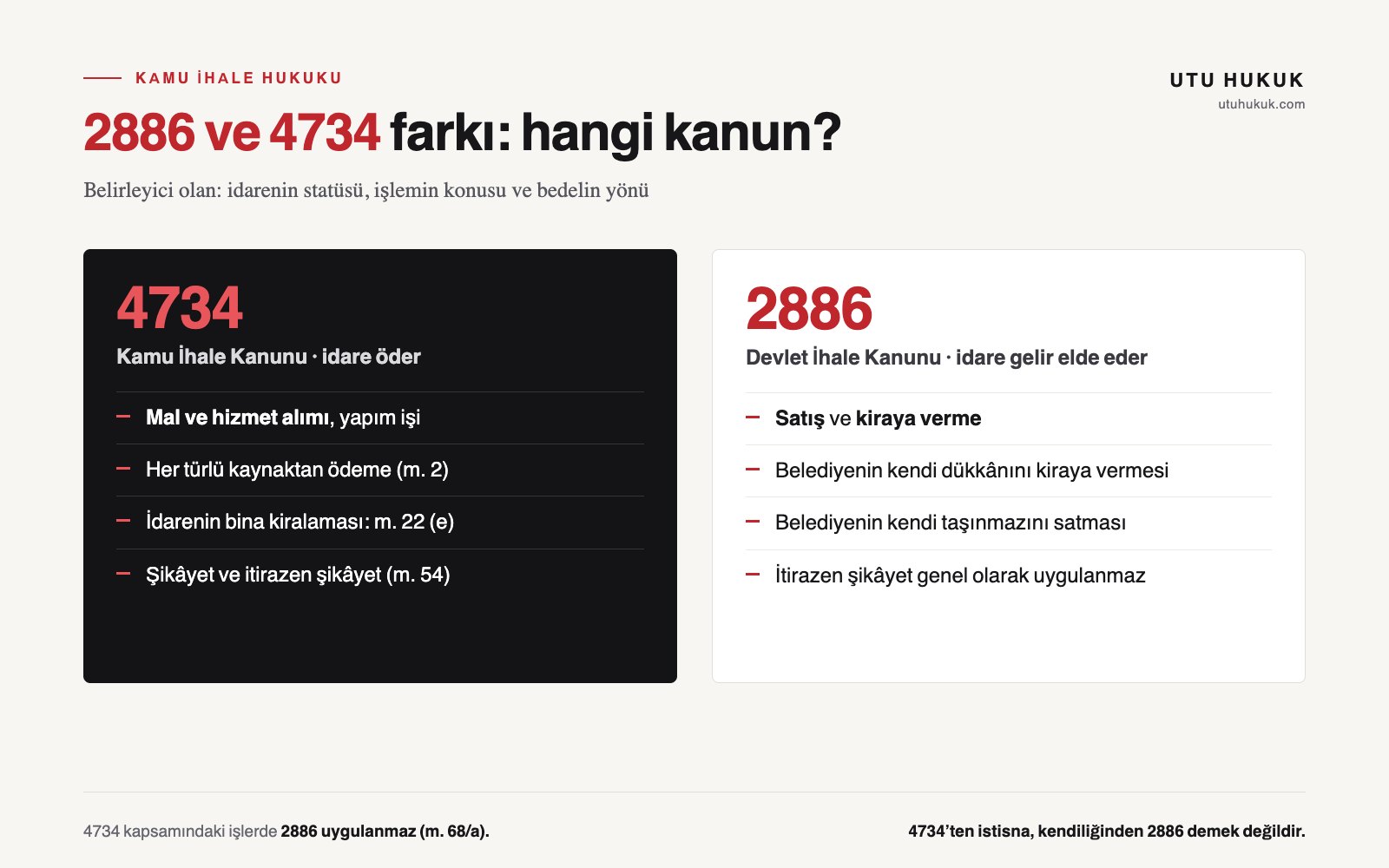
The first question is what the authority obtains through the transaction and in which direction the consideration flows. If the authority obtains computers, cleaning services or the construction of a road and pays the contractor in return, Law No. 4734 comes into play, subject to the scope and exemption requirements. If the authority sells or leases out its own immovable property to generate revenue, Law No. 2886 applies, provided that the authority is subject to Law No. 2886 and there is no special provision.
The authority pays · 4734
Procurement of goods or services or works; the consideration flows from the authority to the contractor.
The authority generates revenue · 2886
Sale or leasing out of immovable property; the consideration flows to the authority.
Dikkat
However, the short explanation “if there is expenditure, 4734; if there is revenue, 2886” is not sufficient on its own. The authority’s position under the scope of both laws, the subject matter of the work and special legislation must be checked. In particular, in hybrid models involving the transfer of the operating rights of a service, the grant of immovable property or rights in return for construction, and revenue sharing, the contract must be examined as a whole.
Because of the expression “any kind of resource” in Article 2 of Law No. 4734, the fact that payment is not made directly from the general budget does not automatically take the transaction outside the scope of the Law. Payment of a service fee from revenue, a fund or a common pool available to the authority may also be significant in terms of the use of public resources. [1, 3]
A frequent source of uncertainty is that the concept of leasing arises under both laws. The decisive factor here is whether the authority is the tenant or the landlord. The definition of service in Article 4 of Law No. 4734 also includes the leasing of movable and immovable property and rights. In addition, subparagraph (e) of Article 22 allows direct procurement for the purchase or leasing of immovable property suited to the authority’s needs. Direct procurement is not one of the tender procedures listed in Article 18 of the Law; it is a separate procurement method regulated in Article 22. [1]
The transactions frequently encountered in practice and their general regimes can be summarised as follows:
General regime in public tenders by type of transaction
| Transaction | General regime | Determining factor |
|---|---|---|
| A municipality purchasing computers | 4734 | Procurement of goods and payment from public funds |
| The administration procuring cleaning or transport services | 4734 | Provision of services to the administration |
| The administration having a building constructed against payment | 4734 | Construction work financed by public funds |
| A municipality leasing out its own shop | 2886 | The administration earning rental income |
| A municipality selling its own immovable property | 2886 | The administration earning sales revenue |
| The administration renting a service building | Public Procurement Law No. 4734, Art. 22(e) | The administration acting as tenant and its need for immovable property |
Assumption underlying the table
The assessments in the table are based on the assumption that the administration concerned falls within the scope of the law and that no specific exemption or different rule applies. Not every transaction bearing the same heading is necessarily subject to the same law.
The decision of the 13th Chamber of the Council of State dated 17 April 2013, E. 2012/2994, K. 2013/1113, shows that the distinction must be drawn on the basis of the actual content of the contract. The dispute arose from the Şanlıurfa Municipality conducting, under Law No. 2886, the tender for the installation of an electronic fare collection system on public transport vehicles and its operation for five years. [3]
The court of first instance dismissed the action on the ground that no expenditure was made from the municipal budget and no appropriation was allocated. The Council of State, however, examined the payment mechanism and reached a different conclusion. Under the system, ticket revenues from municipal buses were also transferred to a common pool, and a total of 5 per cent was paid to the contractor, consisting of 4 per cent for installation costs and 1 per cent for operating costs. The revenues in the pool and the bank accounts were under the control of the municipality.
In addition, the contract provided that, should certain malfunctions arise, the installation cost would be paid by the municipality in monthly instalments of TRY 70,000. The fact that the price was reduced through negotiation in the tender also showed that this amount was not revenue payable to the municipality but consideration payable to the contractor.
The Chamber held that, owing to the use of public funds and the municipality’s payment obligation, the tender should have been conducted under Law No. 4734, and it reversed the first-instance decision dismissing the action. The decision should be regarded not as a final decision directly annulling the tender, but as a reversal that found the dismissal unlawful and required a fresh decision to be rendered. [3]
Practical consequence
The practical consequence of this example is clear: even if the transaction is labelled “operation” or “lease”, where the contractor’s service fee is met from revenue belonging to the administration, Law No. 2886 cannot be chosen on the basis of the label alone. To whom the revenue belongs, under whose control it is held and who bears the payment risk are assessed together.
A distinction must be drawn between the entities excluded from the scope of Law No. 4734 and the exempt transactions listed in Article 3. The fact that an administration falls within the scope of the Law does not mean that all of its procurements are subject to the general tender provisions. For procurements made under an exemption, the relevant sub-paragraph, the specific procedures and principles, and the provisions that continue to apply are examined separately. [1]
An exemption does not automatically mean Law No. 2886
Likewise, the exemption of a transaction from Law No. 4734 does not automatically make it subject to Law No. 2886. The transaction may be subject to a special law, to the rules governing the exemption, or to the entity’s own procurement regime. For revenue-generating transactions, too, the scope of Law No. 2886 with respect to the relevant institution and the legal status of the immovable property must be checked.
For example, while the scope conditions in Article 2 and the exemptions in Article 3 of Law No. 4734 are important for a publicly owned company’s procurement of goods or services, it cannot be said that Law No. 2886 will apply to the same company’s sale of immovable property merely on the ground that “revenue is being generated for the public”. The company’s status and the special provisions to which it is subject must be determined separately.
Incorrectly determining the applicable law may affect the tender procedure, the notice, the qualification requirements, the evaluation of bids and the available remedies. The problem is therefore not merely that a law number has been miswritten in the specifications. Using another regime in place of the mandatory tender regime may render the tender procedures unlawful and lead to their annulment on judicial review. [1, 3]
For tenders falling under Law No. 4734, a complaint to the administration and an objection-complaint to the Public Procurement Authority are provided for, subject to the conditions on standing and time limits. Article 54 of the Law establishes these as administrative applications that must be exhausted before an action is brought. However, special situations concerning direct procurement, exempt procurements or the administration’s decision to cancel the tender cannot be fitted unconditionally into the same general scheme. [1]
In tenders falling under Law No. 2886, on the other hand, the objection-complaint system in Law No. 4734 does not generally apply. The rules on jurisdiction and time limits for judicial remedies concerning tender procedures and for disputes arising from the performance of the contract must be assessed separately. When a dispute arises, the regime to which the work should be subject must be determined, rather than relying on the law number used by the administration in its documents.
Tenders under Law No. 4734
Complaint to the administration and objection-complaint to the Public Procurement Authority; administrative applications that must be exhausted before an action is brought (Art. 54).
Tenders under Law No. 2886
The objection-complaint system does not generally apply; the judicial remedy and the rules on jurisdiction and time limits are assessed separately.
For the consequences of annulled administrative acts for the persons concerned, you may also refer to our article on acquired rights in administrative law .
When assessing which law a tender is subject to, it is useful to check the following points in order:
To determine the correct law in public tenders, the legal status of the administration should be examined first, followed by the actual subject matter and financing of the transaction. Law No. 4734 applies to procurements of goods and services and construction works within its scope, while, as a rule, Law No. 2886 applies to revenue-generating sales and leasing transactions within its scope. In contracts where payment is made from public revenue or which involve mixed obligations, the entire payment and risk structure, rather than the title and the budget entry, should be taken as the basis.
Devletin hüküm ve tasarrufu altındaki kaynaklara ilişkin ayrı bir rejimi maden ruhsatı in our article.
Related legislation: Public Procurement Law No. 4734 (mevzuat.gov.tr)
As a rule, the procurement of goods and services and works carried out by the covered authorities using public resources are subject to the Public Procurement Law No. 4734, while revenue-generating transactions such as sales and leasing out by authorities covered by the State Tender Law No. 2886 are subject to Law No. 2886. However, this distinction must be made by examining together the legal status of the authority, the exemption provisions and the real economic substance of the contract.
No. Law No. 2886 does not apply to tenders for works within the scope of Law No. 4734. Law No. 2886 continues to apply, subject to special provisions, particularly to revenue-generating transactions of the authorities within its scope.
No. The applicable regime is determined by whether the authority falls within the scope and by the nature of the transaction. The mandatory scope of application of the law cannot be changed by the tender approval or the specifications.
No. Payment from public revenue under the authority’s control, or the assumption of a payment obligation by contract, must also be considered. The Council of State decision on the electronic toll collection system illustrates this distinction.
No. The leasing of immovable property by the authority for its own needs is governed by subparagraph (e) of Article 22 of Law No. 4734. The leasing out by the authority of its own building, on the other hand, may be assessed under Law No. 2886 depending on the scope and the requirements of special legislation.
No. Exemption provisions and special legislation are examined separately. The two laws are not the only options that automatically and exhaustively divide all public transactions between them.
Using another regime in place of the mandatory tender regime may render the tender proceedings unlawful and lead to their annulment on judicial review. Incorrectly determining the applicable law may affect the tender procedure, the announcement, the qualification requirements, the evaluation of bids and the available remedies.
The system of appeals (itirazen şikâyet) under Law No. 4734 does not generally apply to tenders under Law No. 2886. The judicial remedy concerning tender proceedings and the jurisdiction and time-limit rules for disputes arising from the performance of the contract must be assessed separately.
Consultation request
As UTU Hukuk Danışmanlık, we provide legal and advisory services in the fields of tax and administrative law.
Fill in the form and we will call you. You can also contact us directly:
