Ankara --:-- · —
bilgi@utuhukuk.com
0536 593 16 00

UTU Hukuk ve Danışmanlık14 min readUpdate:
Reinstatement (revival) of a company, meaning the re-registration, limited to a specific transaction, of the legal personality of a company that has been struck off the trade registry. Why was the five-year peremptory period annulled, and what has the 2026 decision of the Istanbul Regional Court of Appeal brought to practice? In this article we examine the distinction between Article 547 and Provisional Article 7 of the Turkish Commercial Code in the revival of companies struck off the trade registry, the annulment decision of the Constitutional Court, the recent Istanbul Regional Court of Appeal decision and the procedure for a revival action.
The removal of a commercial company from the registry, as a rule, results in the termination of its legal personality and, accordingly, of its capacity to be a party. A struck-off company therefore cannot appear directly as creditor or debtor in an action or enforcement proceedings. Since capacity to be a party is a matter of public policy, it is examined ex officio by the courts and enforcement authorities.
In its decision of 01.10.2018, E. 2018/4016, K. 2018/8889, the 12th Civil Chamber of the Court of Cassation stated that capacity to pursue enforcement proceedings is a matter of public policy and that acts of a person lacking capacity produce no legal effect. In its decision of 04.02.2019, E. 2018/9275, K. 2019/1210, the same Chamber emphasised that a company removed from the registry upon completion of its liquidation cannot be a party to proceedings. Consequently, after removal, asserting a claim against the company or exercising a right belonging to the company often requires the re-registration of the legal personality limited to a specific transaction, in other words, revival.
Revival, as an institution, does not restore the company to unlimited activity with all its past operations. Its essential function is to grant the legal personality a temporary and purpose-bound legal existence so that outstanding liquidation steps or a specific action, enforcement proceeding, arbitration or execution process can be carried out.
In the revival of a company removed from the registry, it must first be determined how the removal took place; the law contains two separate regimes on this matter.
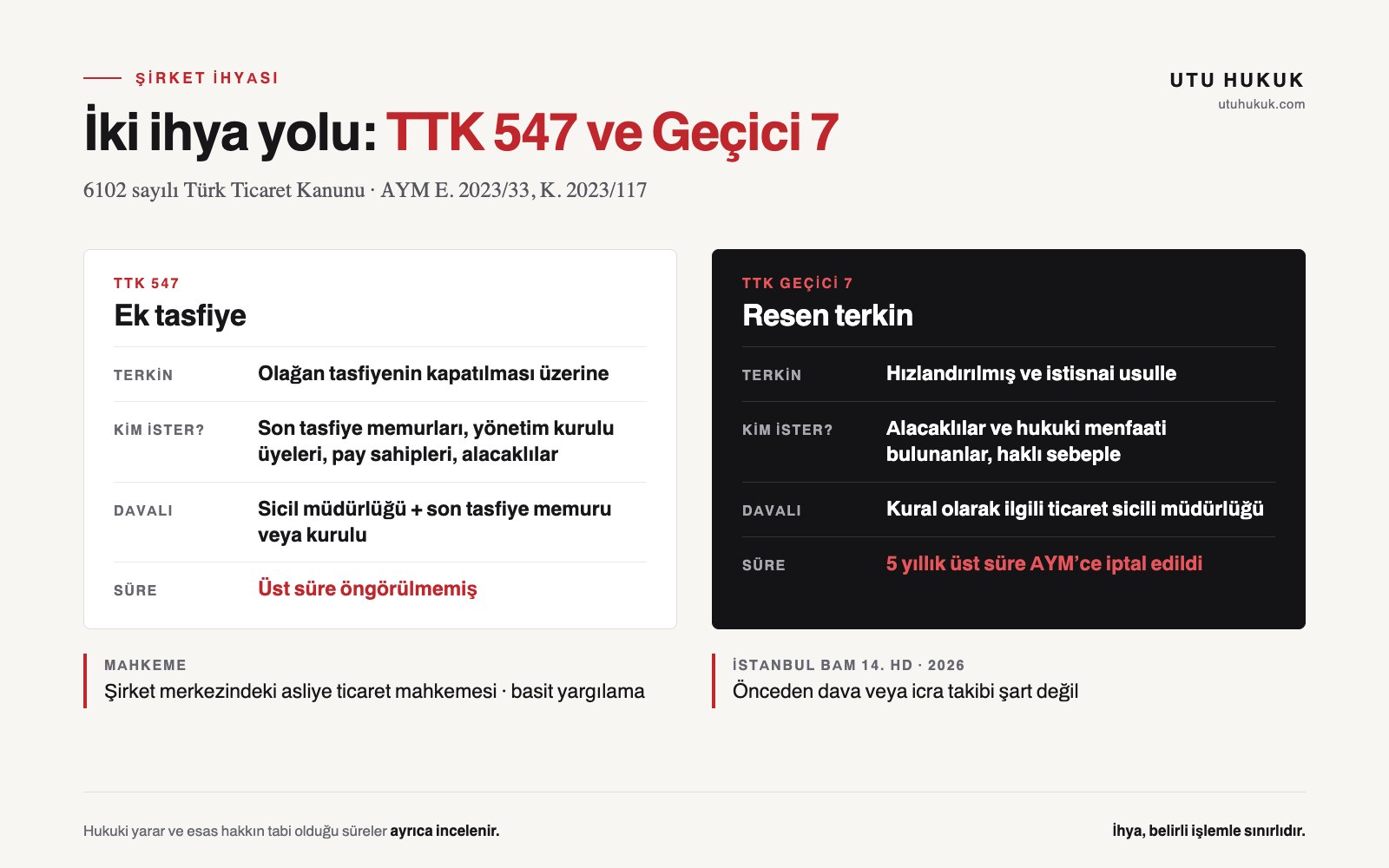
Article 547 TCC governs the situation in which, for companies that entered liquidation in accordance with the procedure and were removed from the registry upon closure of the liquidation, it subsequently becomes apparent that a supplementary liquidation step is necessary. The discovery of forgotten assets belonging to the company, the emergence of an action or arbitration that must be conducted against or in favour of the company, and the need to enforce a decision rendered are typical examples within this scope.
The law grants the last liquidators, the members of the board of directors, the shareholders and the creditors the right to request re-registration from the commercial court of first instance at the place of the company’s head office. If the court finds the request justified, it orders the re-registration of the company limited solely to the necessary supplementary steps and, appointing the last liquidators or a new person or persons as liquidator, has this registered and announced. No separate upper time limit is prescribed for a revival request under Article 547 TCC.
Provisional Article 7 TCC, by contrast, is a provision for the removal from the registry of certain dissolved companies and cooperatives through an accelerated and exceptional procedure compared with the ordinary liquidation procedure. The fifteenth paragraph of the Article allowed creditors and those with a legal interest to request the revival of the company or cooperative on justified grounds; however, it made this application subject to the condition that it be made ‘within five years of the date of removal’.
The Constitutional Court annulment decision relates directly to this wording. For this reason, the sentence ‘the five-year time limit for revival has been abolished’ is incomplete on its own.
Correct statement
The correct statement is as follows: in the revival of companies and cooperatives struck off ex officio under Provisional Article 7/15 TCC, the five-year upper time limit running from the date of removal has been annulled. As regards supplementary liquidation under Article 547 TCC, there is no statutory five-year time limit in any case.
Revival under Article 547 TCC and Provisional Article 7 TCC
| Criterion | Article 547 TCC · Supplementary liquidation | Provisional Article 7 TCC · Ex officio removal |
|---|---|---|
| Manner of removal | Removal upon closure of ordinary liquidation | Removal through an accelerated and exceptional procedure |
| Who may apply | The last liquidators, members of the board of directors, shareholders and creditors | Creditors and those with a legal interest, on justified grounds |
| Defendant | The trade registry directorate and the last liquidator or liquidation committee | As a rule, the relevant trade registry directorate |
| Time limit | No separate upper time limit is prescribed | The five-year upper time limit running from the date of removal has been annulled |
The incorporation and organs of a joint stock company what is a joint stock company and how is it incorporated in our article.
Summary
The Constitutional Court annulled the five-year upper time limit, running from the date of removal, prescribed for the revival of companies and cooperatives removed from the registry under Provisional Article 7/15 TCC. The decision is based on the view that the time limit being exhausted before the claim or legal interest arises, or before the person concerned learns of the removal, could render the revival route ineffective. Nevertheless, the annulment has not converted all revival actions into a single regime. The legal bases, parties and review criteria of supplementary liquidation under Article 547 TCC, which arises after ordinary liquidation, and of revival under Provisional Article 7 must be determined separately.
The Constitutional Court decision of 22.06.2023, E. 2023/33, K. 2023/117, entered into force upon publication in the Official Gazette’s issue No. 32310 of 15.09.2023. The Court examined the contested rule in terms of the right to an effective remedy set out in Article 40, in conjunction with the right to property guaranteed by the Constitution’s Article 35.
A claim against a company that is legally enforceable constitutes an asset within the scope of the constitutional right to property. The State’s obligation is not limited to providing a theoretical avenue of action; that avenue must be accessible, effective and capable of producing results in the specific case.
Under the annulled provision, the time limit ran directly from the date of removal from the registry, not from the date on which the creditor learned of the removal or on which their claim became enforceable. Yet Provisional Article 7’s regime contains no sufficient safeguards to ensure that the persons concerned actually become aware of the liquidation, and it is also possible for certain claims or legal interests to emerge years after the removal.
This structure could mean that the five-year time limit had long expired by the date on which the claim arose or became known; thus, although the revival action appeared to exist, it could become unusable in practice. The Constitutional Court found that running the time limit from the date of removal, without regard to when the justified claim arose, when the person concerned learned or could be deemed to have learned of it and when the claim became legally enforceable, was incompatible with the right to an effective remedy.
The reliability of the trade registry, ensuring that liquidation processes do not remain open indefinitely, and legal certainty are legitimate aims. However, an upper time limit that absolutely extinguishes the rights of persons who had no opportunity to learn that the company had been removed from the registry, or whose claims had not yet arisen, imposed an excessive burden on the persons concerned in pursuit of these aims. The Court therefore unanimously annulled the five-year wording.
The most important consequence of the decision is that, for companies removed from the registry under Provisional Article 7, a revival request can no longer be rejected solely on the ground that more than five years have passed since the removal. Where there is a justified ground and a current legal interest, the five-year objective upper time limit no longer constitutes a bar in itself.
Nevertheless, the decision has not turned the revival request into an unlimited and unconditional right. The applicant must have a legal interest in requesting revival, the claim to be directed at the company must not be abstract, and it must be explained for which transaction or process revival is required. Whether the claim is time-barred, whether any other peremptory period applies, or whether the underlying claim is well founded is assessed separately from the revival action. The Constitutional Court decision does not abolish the time limits in the substantive law rules giving rise to the principal claim.
What changed?
Under Provisional Article 7, a revival request cannot be rejected solely on the ground that more than five years have passed since the removal.
What did not change?
A legal interest is required; the limitation period of the claim, other peremptory periods and whether the underlying claim is well founded are assessed separately.
Date of knowledge
Moreover, the emphasis placed on the ‘date of knowledge’ in the reasoning of the annulment decision does not mean that the Court has introduced a new, general five-year time limit running from knowledge. Acting as a negative legislator, the Constitutional Court removed the existing wording from the legal order; it did not create a new time limit in the law in the form of ‘five years from knowledge’. In practice, the principle of good faith, legal interest and the time limits applicable to the underlying right retain their importance.
The final decision of the 14th Civil Chamber of the Istanbul Regional Court of Appeal dated 07.05.2026, E. 2026/669, K. 2026/870, contains recent and important findings on the conditions for applying revival under Article 547 TCC.
In the dispute, a foreign company argued that the payment’s USD 300,000 portion, paid under a commercial sales contract concluded with the company that had been liquidated and removed from the registry, had not been refunded; it requested the revival of the company limited to the arbitration it would commence before the Istanbul Arbitration Centre and the subsequent enforcement steps. The court of first instance accepted the contract, the pro forma invoice and the payment and refund receipts as documents showing the claim to a minimum extent and ordered revival.
The Regional Court of Appeal expressly stated that it is not strictly necessary for an action or enforcement proceedings to have been commenced before the request for revival. According to the Chamber, since it is mandatory to ensure proper constitution of the parties and the representation of the company in a future action or arbitration against the struck-off company, the submission by the applicant of documents showing the claim to be probable may suffice for a legal interest to be accepted. Conclusive proof of the claim, as well as objections concerning the validity of the contract and the merits of the debt, are matters not for the revival action but for the substantive dispute to be conducted subsequently.
Proper liquidation and litigation costs
The decision further stated that the fact that the liquidation steps were conducted in accordance with the procedure does not prevent a person with a legal interest from requesting revival. On the other hand, in the specific case, where the liquidation announcements had been duly made and the creditor had no action, enforcement proceedings or application before the removal, it was found appropriate not to order litigation costs and attorney’s fees against the liquidator.
A reinstatement action is brought before the commercial court of first instance at the place where the company’s registered office is located. The simple procedure applies under Art. 1521 of the Turkish Commercial Code. This venue is exclusive in claims under Art. 547 of the Turkish Commercial Code.
The determination of the defendants varies according to the manner of removal. In a request for supplementary liquidation based on the TCC’s Article 547 after ordinary liquidation, the trade registry directorate and the last liquidator or liquidation committee must be named as defendants. In an ex officio removal under Provisional Article 7, by contrast, it is as a rule sufficient to name the relevant trade registry directorate as defendant, because under this regime there may be no ordinary liquidation process and no liquidator.
In most disputes the trade registry directorate is in the position of a statutory adversary. If the directorate did not cause the liquidation deficiency, it should not be held liable for litigation costs and attorney’s fees. The liquidator’s liability for costs is determined on a case-by-case basis, assessing their fault in causing the incomplete liquidation, whether they took account of a known claim and whether they gave cause for the action to be brought.
Since legal personality and capacity to be a party end upon removal, proceedings commenced directly against a struck-off company encounter a procedural problem. The enforcement office and the enforcement court are obliged to examine capacity to be a party and to pursue proceedings ex officio. The creditor should therefore, as a rule, first secure the revival of the company limited to the relevant transaction, and then conduct the proceedings or action against the revived legal personality.
The course to be followed in practice is: determining the manner and date of removal from the trade registry records, gathering the evidence supporting the claim, specifying for which action, enforcement proceeding, arbitration or execution step revival is required, and bringing a revival action directed against the correct defendants. After the court decision, re-registration and announcement are carried out, and the appointed liquidator represents the company solely in respect of the supplementary liquidation steps specified in the decision.
The enforcement routes to be pursued after revival enforcement proceedings and their types in our article.
The fact that five years have passed since the date of removal does not mean that a revival request under Provisional Article 7 has automatically lapsed. However, the source of the claim, its due date, when the removal became known and why no application could be made earlier must be documented. Contracts, invoices, bank receipts, correspondence, formal notices, documents of pending actions or arbitrations and registry records are important in establishing a legal interest.
Liquidators should not confine themselves to completing the announcements; they should also inform the creditors known from the company records, operate the deposit or security mechanisms provided for in the TCC’s provisions for debts not yet due or in dispute, and distribute the assets with due regard to the protection of creditors. A liquidation that is incomplete or closed prematurely may lead to the revival of the company and, where the conditions are met, to the liability of the liquidator.
For creditors
For liquidators
The Constitutional Court’s decision E. 2023/33, K. 2023/117 has prevented the institution of revival from becoming a remedy that exists on paper but cannot be used in practice. The removal of the five-year upper time limit tied to the date of removal from the registry has strengthened the right to property and the right to an effective remedy, particularly for creditors who were unaware of the removal or whose claims became enforceable only later.
On the other hand, revival is not an action that resolves the merits of the claim or automatically renders every claim justified. It must first be determined whether the removal took place under Article 547 TCC or under Provisional Article 7; legal interest, the purpose of revival, the correct defendants and the time limits applicable to the underlying right must each be examined separately. The decision of the 14th Civil Chamber of the Istanbul Regional Court of Appeal dated 07.05.2026 also shows that, even where no action or enforcement proceedings have yet been brought, a legal interest in requesting revival may exist if the probable claim is established by documents and the planned proceedings are specified.
We have discussed other matters relating to company membership in our articles on withdrawal and expulsion of members in limited companies and the advantages and disadvantages of joint stock companies and limited companies .
Related legislation: Turkish Commercial Code No. 6102 (mevzuat.gov.tr)
Reinstatement is not an institution that makes the company fully active again, without limitation, with all its past activities. Its essential function is to give the legal entity a temporary, purpose-bound legal existence so that outstanding liquidation steps or a specific action, enforcement proceeding, arbitration or execution process can be carried out.
Turkish Commercial Code Art. 547 governs the situation where, in companies that entered liquidation in accordance with the procedure and were struck off the register upon the closure of liquidation, it subsequently emerges that an additional liquidation step is necessary. Provisional Art. 7 of the Turkish Commercial Code, on the other hand, is a provision for striking certain dissolved companies and cooperatives off the register by an accelerated and exceptional procedure compared with the ordinary liquidation procedure.
For the reinstatement of companies and cooperatives struck off ex officio under Provisional Art. 7/15 of the Turkish Commercial Code, the five-year outer time limit running from the date of removal has been annulled. As regards additional liquidation under Art. 547 of the Turkish Commercial Code, there is in any event no statutory five-year time limit. Whether the receivable has become time-barred or whether any other peremptory period applies is assessed separately from the reinstatement action.
The Constitutional Court decision of 22.06.2023, E. 2023/33, K. 2023/117, entered into force upon publication in the Official Gazette’s issue No. 32310 of 15.09.2023. The Court unanimously annulled the five-year wording.
The 14th Civil Chamber of the Istanbul Regional Court of Appeal expressly stated that it is not necessarily required for an action or enforcement proceedings to have been initiated before the request for reinstatement. The applicant’s submission of documents showing the receivable to be probable may be sufficient for legal interest to be accepted.
A reinstatement action is brought before the commercial court of first instance at the place where the company’s registered office is located. The simple procedure applies under Art. 1521 of the Turkish Commercial Code. This venue is exclusive in claims under Art. 547 of the Turkish Commercial Code.
In a request for supplementary liquidation based on the TCC’s Article 547, the trade registry directorate and the last liquidator or liquidation committee must be named as defendants. In an ex officio removal under Provisional Article 7, by contrast, it is as a rule sufficient to name the relevant trade registry directorate as defendant.
Since legal personality and capacity to be a party end upon removal from the register, proceedings initiated directly against a struck-off company run into a procedural problem. As a rule, the creditor should first obtain the reinstatement of the company limited to the relevant transaction, and then pursue the enforcement proceedings or action against the reinstated legal entity.
Consultation request
At UTU Hukuk Danışmanlık, we provide legal representation and advisory services in the field of company law.
Fill in the form and we will call you. You can also contact us directly: